
To rank higher on the App Store or the Google Play Store, you need more than a keyword-stuffed title. Apple describes search results as depending on text relevance and user behavior, including downloads, ratings and reviews. Strong conversion and a useful product help turn visibility into sustained growth. That means tighter metadata, a product page built to convert, healthy ratings and reviews, and an ongoing test cycle - not a one-time text update.
The ASO Project is a full-service App Store Optimization agency that runs this work for mobile apps, with monthly service starting at $2,500/month.
What actually moves App Store and Play Store rankings
App Store search is a relevance engine and a quality engine at the same time. If your title, subtitle, and keyword field do not clearly match what a user typed, you will struggle to appear. When you appear, a clear product page helps turn that visibility into downloads. Apple does not publish the full ranking formula or the weight of each factor.
In practice, the teams that climb and stay there work on four things together:
- Metadata relevance. Title, subtitle, keyword field, and the rest of your listing text should target the queries you can realistically win, not every popular term in your category.
- Conversion rate. A higher conversion rate does not just produce more downloads from the same traffic. More downloads can support visibility, but Apple does not explicitly confirm conversion rate as an independent ranking factor. Our conversion rate optimization service focuses on measurable install gains.
- Post-install quality. Engagement, retention and uninstall trends help you judge whether you are acquiring the right users. They matter to business results, even where their direct ranking effect is not publicly confirmed.
- Velocity and consistency. Track changes across multiple cycles, with consistent measurement rather than assuming one metadata push will produce a durable result.
This is why a “set it and forget it” keyword update rarely produces a durable jump. Rankings compound when research, implementation, and measurement run on a cycle.
Start with keyword research, not guesswork
Before you rewrite your title, map the landscape. You need to know which terms already drive installs, which terms your competitors own, and which opportunities are both relevant and realistically attainable.
A useful keyword landscape answers four questions:
- What do users actually type when they are looking for a product like yours?
- Which of those terms already convert for you today?
- Where is there volume you are not capturing, and how strong is the competition?
- Which terms are relevant enough that a high rank would bring the right users, not just more traffic?
Volume without relevance is a trap. Ranking for a popular term that does not match your app can raise impressions and hurt conversion, without necessarily bringing valuable users. The better approach is to prioritize a tighter set of terms, win those, and expand.
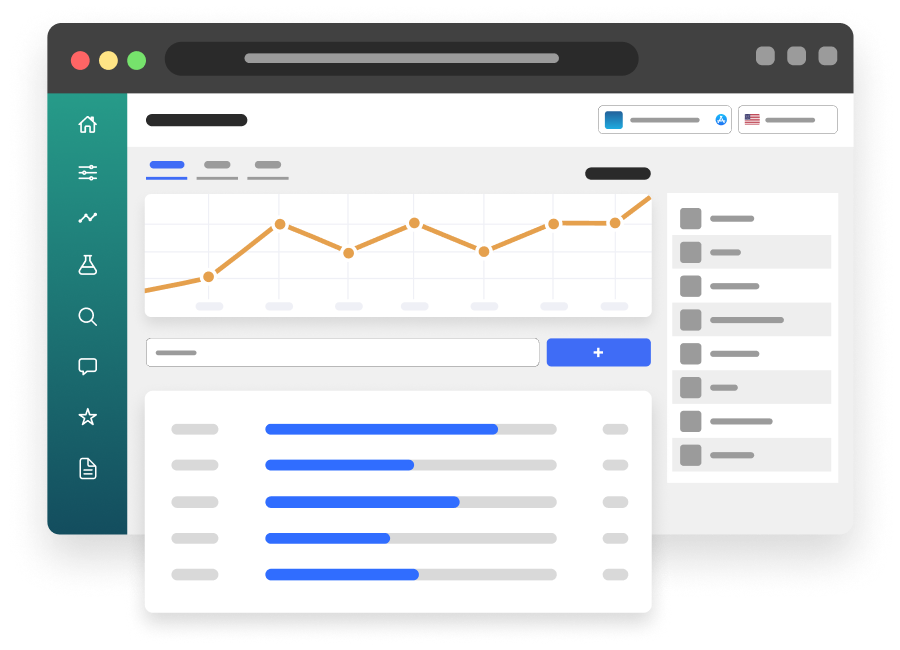
Our team uses both manual research and programmatic tools to build this landscape, then refines targets based on competition, opportunity, and volume. That process is the core of our search visibility work, and clients can follow the resulting rankings in our ASO Dashboard.
Optimize the metadata Apple actually uses
Once you know the targets, put them in the fields that matter, in plain language a shopper would trust.
Title. This is a key search-relevance field on your product page. Lead with your brand if it carries recognition, and include a primary, clearly relevant keyword where it reads naturally. Do not cram several unrelated phrases into the title. A readable title helps both users and the ranking system.
Subtitle. Use this line to cover a second high-value theme, a core use case, or a differentiator the title could not hold. The subtitle should make sense on its own in search results, not repeat the title with synonyms stacked together.
Keyword field. This field is not visible to users, but it is a core relevance input. Use it for important variants you could not fit in the title or subtitle. Do not repeat words already used in the title or subtitle, and do not waste characters on “app,” your brand name, or unnecessary spaces. Separate terms with commas and use the available space deliberately. Treat the character limit as a scarce resource.
Description and the rest of the listing. Promotional text, the description, in-app events, and other text elements will not do the same work as the title, but they still help users convert rather than being treated as equivalent search-indexing fields. Apple’s description and promotional text are not keyword fields; Google Play uses different metadata for discovery. We optimize any text associated with your listing - titles, subtitles, short and long descriptions, keywords, in-app events, promotional content, custom store listings, and featured in-app purchases - on the App Store and Google Play, in the markets you target.
Rewrite with restraint. A complete swap every week makes it hard to learn what worked. Ship a clear hypothesis, give it time to index and accumulate data, then iterate.
Turn search visibility into downloads
Getting in front of more searchers only helps if a larger share of them install. Screenshots, your icon, preview video, and the first three search-result assets often do more to win the tap than a description paragraph.
Treat conversion work as part of the broader growth program:
- Build screenshot sequences that explain the value of the app in a few readable frames, with callouts large enough to parse in search results.
- Test icon, screenshot, and preview-video variations with Product Page Optimization rather than shipping a redesign and hoping.
- Use Custom Product Pages to match specific audiences and use cases. They can support Apple Ads and can also appear in organic search for assigned keywords, subject to Apple’s availability and requirements.
We cover this in depth in How to improve your App Store conversion rate, and our design team can run the creative and testing work for you.
Use ratings, reviews, and replies as a ranking and conversion asset
Ratings and reviews influence whether someone trusts your listing, and they are part of the quality picture the store sees. A strong average rating and a steady flow of recent, authentic reviews help both conversion and visibility. A sudden drop, a wave of unanswered complaints, or a stale review profile does the opposite.
Practical habits that help:
- Invite established users to leave an honest review at a natural moment in the app - never in a way that violates store policies or prompts only positive reviews.
- Watch incoming reviews closely, by country and version, so a release issue does not sit unanswered.
- Reply to reviews. A thoughtful reply helps the user and shows future readers that a real team is behind the app.
Our Reviews Manager tracks reviews hourly, surfaces sentiment and keyword themes, and lets teams reply from one dashboard, including AI-assisted replies and translations. Review management is available within the agreed ASO scope.
How ranking works differently on the Google Play Store
The Play Store rewards the same fundamentals - relevance, conversion, and a quality app - but it reads your listing differently, so an App Store plan cannot simply be copied across.
- No hidden keyword field. Google Play indexes your visible text instead: the app title (up to 30 characters), the short description (up to 80 characters), and the full description (up to 4,000 characters). Write these for people first, with your priority terms used naturally - repetitive keyword stuffing can breach Google Play policy.
- App quality is visible to the store. Google has said that technical quality, such as crash and ANR rates reported in Android vitals, can affect how prominently an app is shown. Engineering health is part of Play Store ASO.
- Experiments and custom listings. Store listing experiments let you test icons, graphics, and text, and custom store listings let you tailor the page for specific countries or audiences.
- Promotional content. Events, offers, and major updates can appear across Google Play surfaces and give users a reason to return.
We run keyword research, metadata, creative, and testing separately for each store, so your Play Store listing is built for Google Play rather than ported from iOS.
Localize if you want to rank in more than one country
A US-English listing will not reliably rank for the way users search in Germany, Japan, or Brazil. Each storefront has its own keyword landscape, competitors, and creative expectations. Translating your US title word-for-word is not a localization strategy.
To rank in a new country, run country-specific keyword research, write metadata for how people actually search there, and adapt screenshots and videos so they feel native. We explain that approach in Who can localize App Store and Google Play listings and on our localization service page.
Let paid search and organic ASO support each other
Apple Ads can put your app in front of high-intent searchers while organic rankings are still being built, and the queries that convert in paid search are often excellent organic targets. The reverse is also true: a product page that converts organic traffic will usually convert paid traffic more cheaply.
This is why we manage Apple Ads and organic ASO as one program when clients want both. Ads are optimized toward downstream MMP metrics, and Custom Product Pages align the post-tap experience with the keyword that earned the click. Paid spend is not a substitute for ASO, but it is a powerful partner.
Use a cycle, not a one-time refresh
ASO is not a single keyword update. The process that consistently improves rankings looks like this:
Audit and research. Understand the app, the audience, and the competition. Establish a baseline and build a keyword, messaging, and optimization roadmap.
Implement and test. Put the research to work with new metadata and, when the scope includes it, new creative. Launch optimizations and test variations.
Learn and optimize. Review the data, keep what is working, and ship the next round. Multiple cycles produce more learning than a one-time refresh.
Our monthly engagements start with a three-month initial agreement so there is time to audit, implement, and test more than once. After that, work continues month-to-month. You should stay because the work keeps proving its value, not because a long contract says you have to. See pricing for how that is structured.
How The ASO Project helps you climb - and stay there
You can do this work in-house, and many teams should own part of it. If you want a specialist team and the tooling already built, we run the full cycle with you.
What you get when you work with us:
- A senior ASO specialist in direct communication, with a senior strategist on the account and designers when creative is in scope.
- Keyword and competitor research, with metadata shipped every cycle.
- Conversion-rate creative and split testing when that work is in scope.
- Review management and localization when agreed in scope, plus the option to add Apple Ads and Google App Ads.
- Access to our ASO Dashboard, AI-assisted analysis, a dedicated Slack channel, bi-weekly meetings, and reporting.
Monthly service starts at $2,500/month. If you are not ready for an ongoing engagement, launch packages start at $6,000 one-time and deliver the initial research, optimizations, and tests you need to ship. Tell us about your app and we will come back with a free audit and a clear plan.
A practical first test
For a budgeting app, compare a first screenshot focused on “See where your money goes” with one focused on “Build a budget you can stick to.” Keep the remaining assets unchanged so you can interpret the result. This is an example test hypothesis, not a promised outcome.
Apple’s App Store search guidance explains the published ranking factors and Custom Product Page keyword support.