
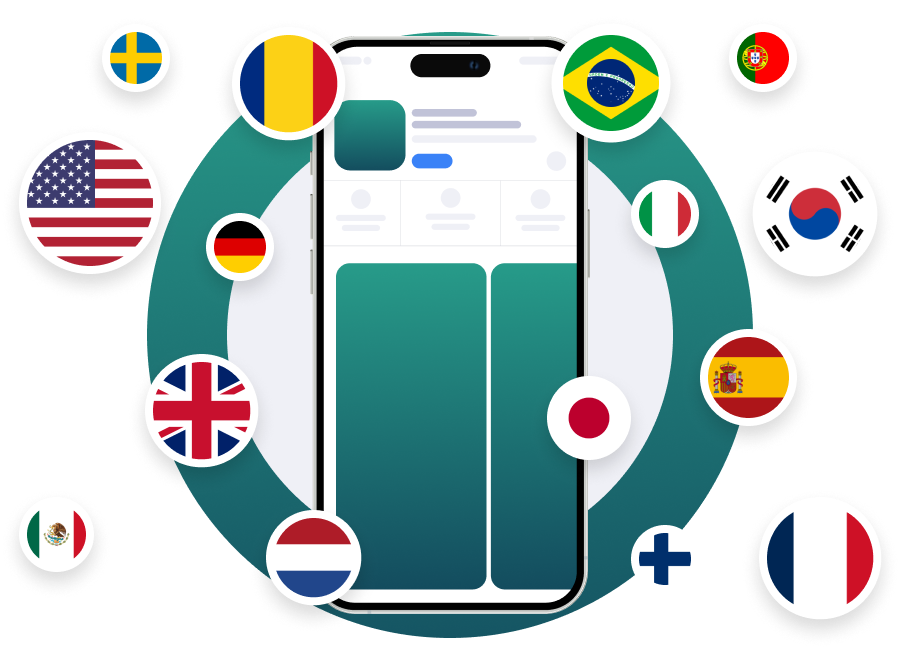
The right partner for App Store and Google Play localization is a team that researches keywords in each country, writes metadata for how people actually search there, and adapts screenshots, videos, and other creative so they feel native - not a vendor that only translates your English listing. The ASO Project is a full-service ASO agency that localizes listings for any country and language we take on, using country-specific strategy, in-house technology, and a network of native speakers, as part of managed ASO starting at $2,500/month.
Translation is not localization
If you take a US title, subtitle, and screenshot callouts and translate them line by line, you will often miss the terms people really use in that market. You may also ship cultural references, visual tropes, or benefit statements that do not land.
Localization for the stores means:
- Different keyword landscapes. The way a habit-tracker, fintech, or photo app is searched in Spain is not a dictionary match for the US terms.
- Different competitors. The apps you need to outrank - and the creative patterns users expect - change by country.
- Different creative expectations. Color, imagery, typography, social proof, and even how much text sits on a screenshot can vary. Users in different countries have different cultures and expectations.
This is one of the highest-leverage ASO investments available, and it is also one of the most commonly underdone. Expanding into new storefronts with translated copy leaves rankings and conversion on the table.
What a complete localization program covers
Our localization work focuses on every element of the app’s page in each country, not keywords alone.
Text and metadata:
- Titles
- Subtitles
- Short descriptions
- Long descriptions
- Keywords
- In-app events
- Promotional content and other listing text
Creative and store assets:
- Screenshots
- App icons where a market-specific treatment is warranted
- Preview videos
- Custom Product Pages
- Feature graphics and other store artwork
If it is text or a visual asset associated with your listing, it can be localized for the App Store and Google Play in the markets you target. We do not treat localization as a subtitle-only task.
How The ASO Project localizes
Country-specific strategy. We research and analyze the top keywords and competitors in each country. Each storefront gets its own approach. As we say on our localization service page: localized keywords, not translations, with per-locale reporting.
Localization technology. Our technology supports any language we work in on the app stores. We use it to identify top keywords and trends in a country, and to track how optimizations perform after they ship.
Culturalization. Expertise and a network of native speakers help make sure optimizations, graphics, and videos are culturally relevant and appropriate - not just linguistically correct.
Market prioritization. If you cannot localize everywhere at once, we help you choose where to start: opportunity, competition, current traffic, and operational readiness, not a generic “top 10 languages” list.
How this ties to rankings, conversion, and ads
Localization is not a side project. It is ranking work and conversion work in every new storefront.
- To rank higher in a country, you need metadata built for that country’s queries.
- To improve conversion, you need creative that reads as native and is still tested, not only translated.
- If you run Apple Ads or Google App Ads in those markets, localized Custom Product Pages and ads creative keep the post-tap experience consistent.
One team can keep those pieces aligned. That is the point of hiring an ASO agency for localization instead of sending files through a generic translation vendor and a separate media team.
What it looks like to work with us
Localization can be scoped as part of a broader ASO engagement or as the focus of the work. Monthly ASO service starts at $2,500/month, and additional countries, creative, or stores affect the final price we agree on together. Your agreed scope sets the specialists and deliverables; dashboard access, Slack and bi-weekly meetings support the work.
We will not pretend every market should be launched in week one. The audit should produce a sequenced plan: which countries first, which assets need native creative (not just metadata), and how we will report results per locale.