

Apple4 min read
Apple's Policy Changes in Europe
Apple today announced changes to iOS, Safari, and the App Store impacting developers’ apps in the European Union (EU) to comply with the Digital Markets Act (DMA). Details and takeaways below:
Back to the blogUnderstanding the Changes
The Digital Markets Act (DMA) and Third-Party App Stores
Under the European Union's Digital Markets Act (DMA), Apple has made a groundbreaking change by allowing third-party app stores on its devices. This move breaks Apple's long-standing practice of exclusively hosting apps on its own App Store. The DMA aims to foster fair competition and innovation in the digital sector, particularly targeting large tech companies that act as "gatekeepers."Implications for Developers:
- Increased Distribution Channels: Developers can now choose from multiple app stores, potentially reaching a wider audience.
- Diverse Monetization Strategies: With different platforms come varied monetization options and fee structures, offering more financial flexibility.
- Adaptation to Multiple Store Policies: Developers must adapt to different store guidelines and operational frameworks.
Core Technology Fee
OnOne of the pivotal updates is the introduction of the Core Technology Fee. Apple has established this fee as a means to cover the costs of various core technologies integral to the iOS ecosystem, which developers benefit from. Utilize the Core Technology Fee calculator tool that Apple has provided to estimate the potential impact on your business.What The Fee Covers:
- Access to core technologies like Apple's APIs, development tools, and software.
- Security features like Apple’s robust privacy and encryption systems.
- The integration of Apple’s payment processing system.
Calculating the Fee:
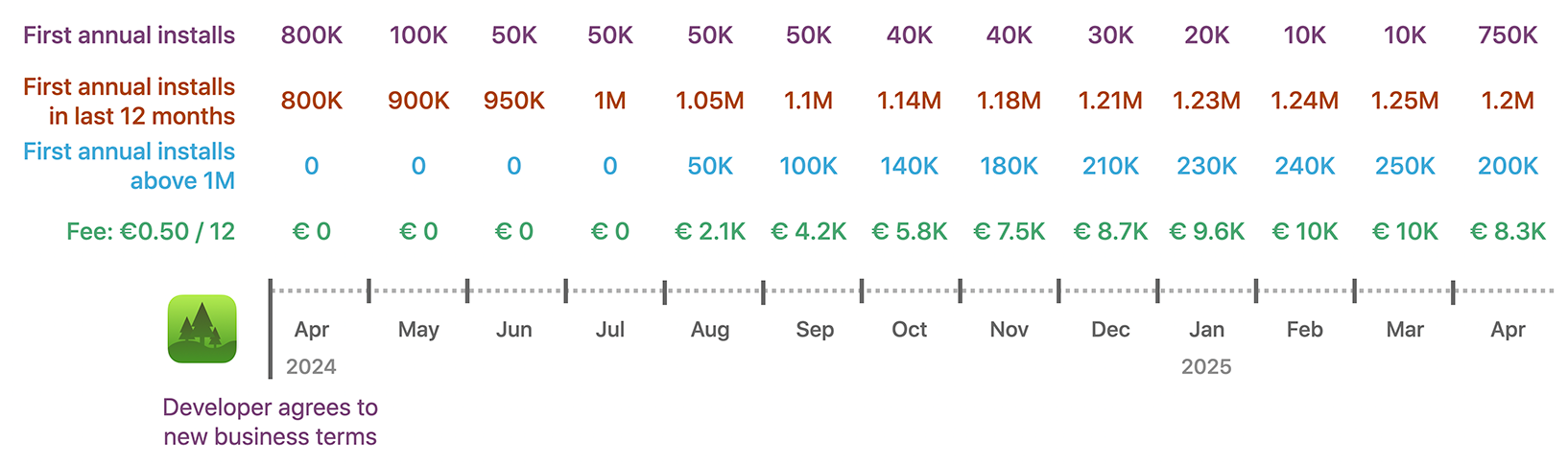
- The Core Technology Fee is calculated by looking at the number of first annual installs in the past 12 months. On a monthly basis, developers will only be billed for one-twelfth of the Core Technology Fee for each first annual install in excess of one million. If an app has fewer than one million first annual installs, there will be no Core Technology Fee for that app that month.
Impact on Developers:
- Cost Considerations: Developers must account for this fee in their financial planning and pricing strategies.
- Ensuring Compliance: Understanding what the Core Technology Fee entails and how it applies to different development scenarios is crucial for developers.
Options Developers Have:
- Current App Store Agreement
- Developers still pay the standard 15 to 30 percent fee.
- One million in revenue is a 15 percent commission (App Store Small Business Program)
- Over one million in revenue results in a 30 percent commission
- Subscriptions have a 30 percent commission for the first year, and then drops to 15 percent for the following years.
- New terms, App Store distribution
- App Store IAP fees reduce from 30 to 17 percent and 15 to 10 percent, respectively.
- There is an additional fee of 3 percent for using Apple's IAP payments, changing the fees to 13 and 20 percent for a developer that opts for the new rules and uses in-app purchases.
- The 3 percent fee does not apply to developers who use alternative payment systems. Developers must also pay the Core Technology Fee.
- New terms, alternative app store distribution
- No fees, but developers must pay the Core Technology Fee on installs over the first million annually.
Navigating the New Policies
Strategies for Developers:
- Explore Options for Distribution: Evaluate how your app will be distributed and identify those that align best with your app’s niche and target audience.
- Adapt to Diverse Guidelines: Be prepared to tailor your app to meet the standards and requirements of different app stores.
- Determine Which Option Suits Your App: Keep fees as-is, use alternative payment methods but pay the Core Technology Fee? These are things each developer should weigh individually.
- Financial Planning: Incorporate the Core Technology Fee into your budgeting, especially if you’re leveraging Apple’s core technologies extensively.
- Stay Informed: Keep abreast of further policy updates and adapt your strategies accordingly.